Warsaw Through Office Glass: A High-Rise Perspective on Poland's Capital, 2019
This post documents my visual journey through different times of day and atmospheric conditions from a high-rise office window in Warsaw during 2019. From golden afternoon light illuminating the city’s distinctive skyline to the nocturnal transformation when LED-lit towers paint the sky in rainbow colors, these photographs capture more than architecture—they preserve moments of reflection between deadlines, quiet observations of urban rhythm, and the peculiar intimacy of watching a city from above.
Location: High-rise office building, Warsaw city center, overlooking Złote Tarasy and the central business district. Equipment: Smartphone camera (realistic documentation rather than professional photography). Period: March 2019. Skills Documented: Urban observation, appreciation of architectural context, finding beauty in everyday surroundings.
The Setting: Working Above the City
Walking into that office building each morning in 2019 meant entering a vertical city. The elevator ride became a daily ritual—watching floor numbers climb, feeling that slight pressure change in your ears, occasionally making awkward small talk with colleagues you recognized but didn’t know well enough to greet by name. Then the doors would open on our floor, and there it was: that view.
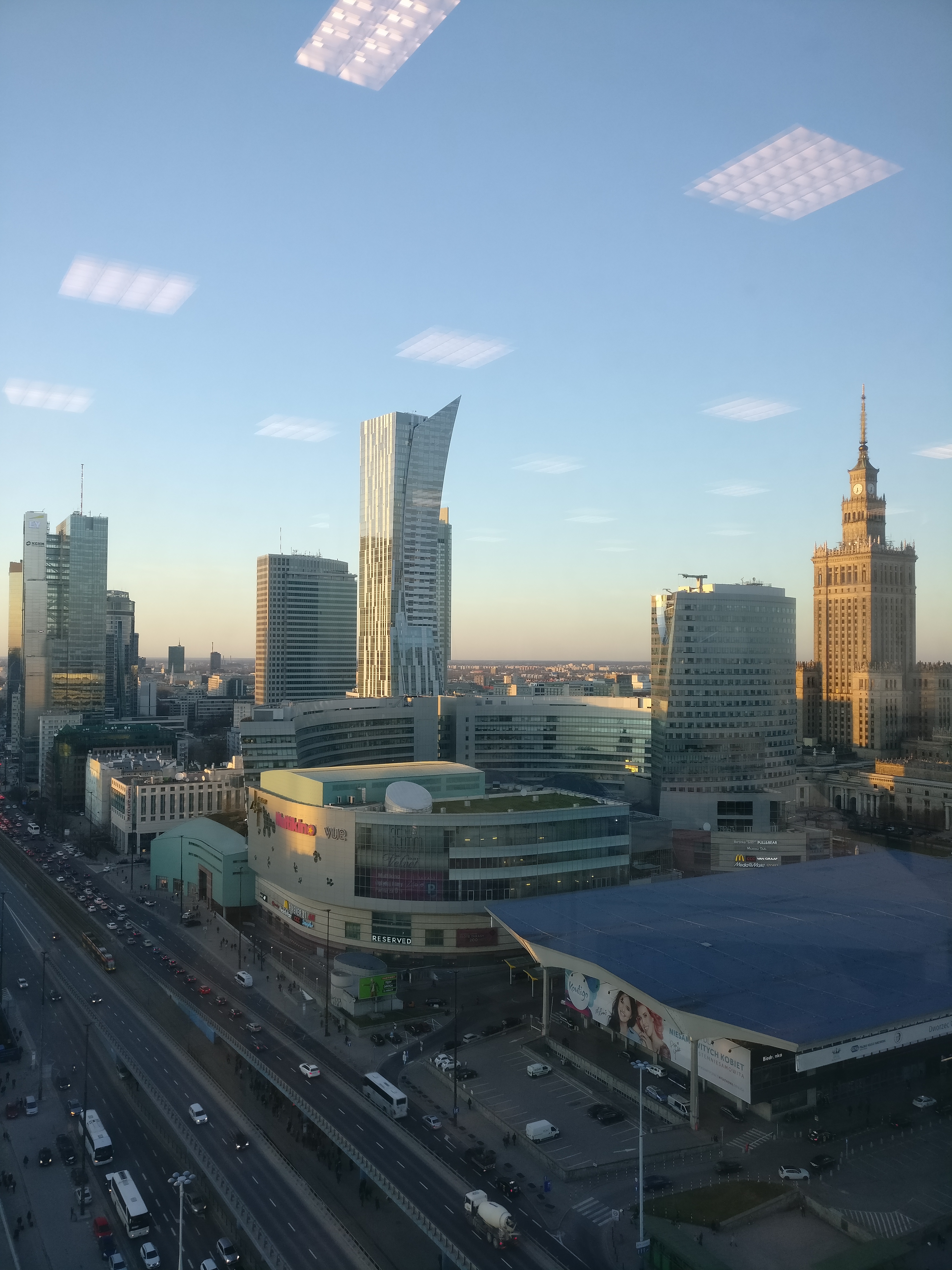
- Afternoon panorama with Warsaw Spire and Palace of Culture visible
Floor-to-ceiling windows stretched across one wall of our office space, transforming what could have been just another corporate environment into something more-an observation deck from which to watch Warsaw live its life. The irony wasn’t lost on me: we spent our days behind desks, staring at computer screens, attending meetings in windowless conference rooms, yet this spectacular view remained constantly available, waiting for those moments when we’d look up from our work and remember the world existed beyond our tasks.
The building stood in Warsaw’s financial district, surrounded by the architectural manifestations of Poland’s post-1989 transformation. To the west, the Warsaw Spire that distinctive twisted tower with its angled crown-dominated the middle distance. Rising 220 meters, it represented one of Warsaw’s newer additions, completed in 2016. Its slanted top wasn’t just aesthetic flourish; the 45-degree angle created iconic silhouette recognizable across the city. Beyond the Spire, always present like a stern guardian from another era, stood the Palace of Culture and Science. At 237 meters, it remained Warsaw’s tallest building despite decades of attempts by modern towers to surpass it. This Soviet-era giant, completed in 1955 as Stalin’s “gift” to Poland, evoked complicated feelings among Varsovians. Some called for its demolition, seeing it as monument to oppression. Others argued for preservation as historical artifact. Most just accepted it as part of Warsaw’s identity—controversial, impossible to ignore, undeniably distinctive.
The View’s Architecture: Reading Warsaw’s Layers
Our vantage point revealed Warsaw as layered city-literally and historically. In the immediate foreground, the Złote Tarasy shopping center spread its distinctive curved glass and steel roof. Designed by architecture firm Jerde Partnership and completed in 2007, its wave-like canopy was meant to evoke the Vistula River’s flow. From above, it resembled giant soap bubbles pressed together, each curve catching and reflecting light differently throughout the day. The building below housed major retail brands, restaurants, and entertainment venues. It connected directly to Warsaw Centralna railway station, making it constant hub of human traffic. During lunch hours, I’d watch tiny figures—people reduced to moving dots from our elevation—stream in and out of entrances, following patterns as predictable as ant colonies. Morning rush brought commuters. Lunch hour filled the outdoor plaza. Evenings saw a different crowd: diners, cinema-goers, teenagers gathering in groups.
Surrounding the immediate area, Warsaw’s street grid revealed itself from our height. Unlike organic medieval cities that grew along wandering paths, Warsaw’s post-WWII reconstruction followed Soviet planning principles: wide boulevards capable of accommodating military parades, regular blocks, symmetrical layouts. The main artery visible in our photos—Jana Pawła II Avenue—stretched six lanes wide, a constant river of traffic flowing north-south through the city center.
The traffic patterns themselves told stories. Morning rush meant southbound lanes backed up with commuters entering the city center. Evening reversed the flow. Weekends saw lighter traffic but different character—families heading to shopping centers, tourists navigating rental cars, delivery trucks making rounds. From our elevation, individual vehicles merged into patterns: red taillights flowing one direction, white headlights the other, occasionally interrupted by colored buses and yellow taxis punctuating the stream.
Construction cranes dotted the skyline, permanent fixtures in Warsaw’s 21st-century landscape. The city was perpetually rebuilding, always becoming something new. During my time there in 2019, several major developments were underway. Varso Tower—destined to become the EU’s tallest building at 310 meters—was rising to the northwest, though not visible from our particular angle. Other projects filled gaps in the skyline, transforming parking lots and low-rise Soviet structures into glass towers housing international corporations, luxury apartments, and upscale hotels.
Afternoon Light: The City in Golden Hour
Late afternoon brought the day’s most spectacular display. As the sun descended toward the western horizon, its light took on that warm, golden quality photographers call “magic hour.” Everything turned amber and honey-toned—glass towers caught and reflected the light, concrete structures glowed warm, even the constant traffic seemed less harsh under this flattering illumination.
This first photograph captures that exact quality. The time stamp reads 17:32—mid-March in Warsaw meant sunset around 18:00, placing us in that sweet spot about thirty minutes before solar completion. The light comes from behind and to the right of our viewpoint, painting the scene with directional warmth that creates long shadows and emphasizes the vertical relief of buildings.
Look at the Warsaw Spire in this image. Its western face catches the full force of the descending sun, making it appear almost to glow. The building’s distinctive facade—alternating bands of glass and white concrete—creates a rhythm visible even at this distance. The angled top, which appears somewhat aggressive in neutral lighting, takes on elegant, aspirational quality in this light, like a finger pointing skyward toward possibilities.
The Palace of Culture, farther in the distance, presents differently. Its Soviet neoclassical architecture—all that decorative stonework, the tiered wedding-cake structure, the spire topped with Polish flag—reads as solid mass rather than transparent glass. In afternoon light, it appears warm but substantial, grounded rather than ethereal. The building occupies square footage that modern developers salivate over, yet there it remains, stubbornly monumental, surrounded by glass towers that try to dwarf it but somehow never quite succeed.
Down below, the Złote Tarasy roof creates abstract composition of curves and reflections. Each “bubble” of the roof structure catches light differently—some appear nearly white with direct reflection, others show the blue of sky, still others reveal darker tones where shadows fall between curves. It’s architectural photography rendered accidentally, simply from elevation and timing.
The human scale appears in vehicles and the tiny figures visible in parking areas and plazas. At this distance and resolution, individuals become abstract representations—you can see someone exists there, moving through space, but cannot discern features, gender, age. This abstraction creates strange emotional distance. Those aren’t people; they’re movement patterns, statistical data points in urban flow analysis. Yet simultaneously, you know each represents complete human life—someone with concerns, destinations, relationships, dreams.
I remember standing at this window during a particularly frustrating afternoon. Some project deadline had been moved up arbitrarily, requiring weekend work. Email chains had devolved into passive-aggressive exchanges about whose responsibility certain tasks were. The climate control kept the office slightly too cold. And I stood there, coffee cup warming my hands, watching the city below and thinking about all those people down there, each dealing with their own versions of workplace absurdity, traffic frustrations, relationship complications.
It provided strange comfort, actually. The city’s scale made individual concerns feel proportionally smaller. Not in a dismissive way—my problems were real enough—but in a contextual way. This enormous city kept functioning regardless of my project deadlines. Millions of people navigated their own challenges. The sun descended toward horizon whether or not my presentation slides were ready. There was peace in that perspective.
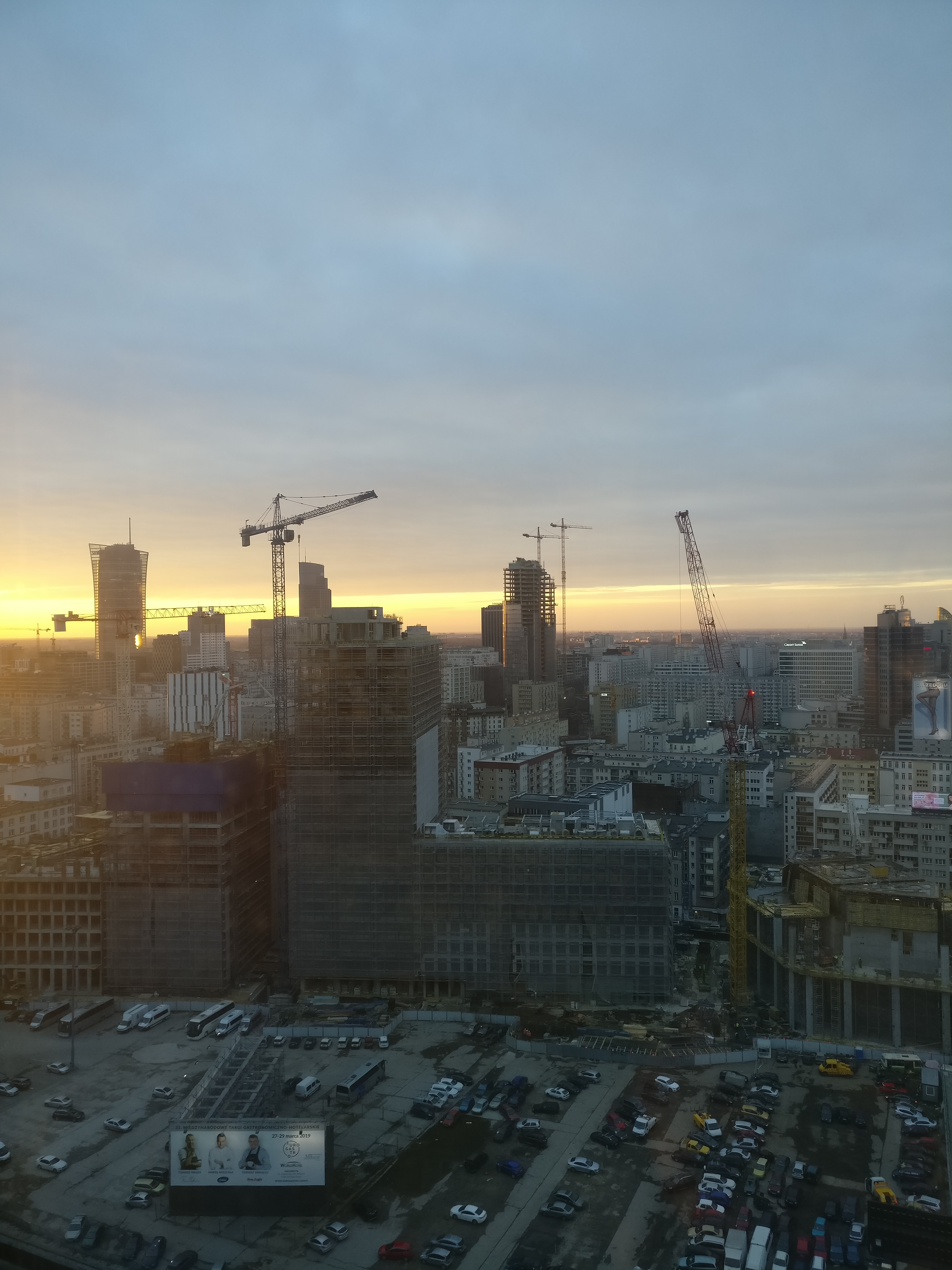
- Construction cranes silhouetted against sunset sky
Construction Eternal: Warsaw Rebuilds Itself
This second photograph, captured five days later at 17:49, shows a different perspective looking more northward. The sunset here burns along the entire western horizon, creating dramatic backdrop against which construction cranes stand as dark silhouettes. Count them—I see at least six cranes clearly visible in this frame, and those represent only the ones within this particular viewing angle. At any given time in 2019, Warsaw probably had fifty or more major construction projects underway simultaneously.
The cranes became running joke among office workers. “How do you know it’s spring in Warsaw?” someone would ask. “The construction cranes migrate back.” They were as much permanent fixtures as any actual building, standing sentinel over transformation sites for months or years. We’d watch buildings rise floor by floor, a real-time time-lapse visible from our windows. One project northwest of us went from excavated pit to fifteen-story tower during my tenure there—approximately eighteen months compressed into a visible narrative of construction progress.
The sunset in this image deserves attention. The entire western quadrant of sky glows with graduated color—deep orange at the horizon gradually shifting through yellow toward pale blue above. This gradient creates natural backdrop that renders the cranes and distant buildings as graphic silhouettes, all detail lost to backlighting, reduced to pure shapes against luminous sky.
This kind of sunset happens when the atmosphere contains just the right amount of particulate matter—not enough to obscure the sun (which would create grey, diffuse light) but sufficient to scatter shorter wavelengths, leaving the longer red and orange wavelengths to dominate. Urban areas, with their constant emissions, often create spectacular sunsets precisely because of this particulate content. There’s irony there: pollution creates beauty.
The foreground shows more parking lots and lower structures, including what appears to be a parking garage roof. These functional, unglamorous spaces contrast sharply with the distant glass towers and dramatic sky. Warsaw, like any real city, consists mostly of this mundane infrastructure—parking, service areas, loading docks, utility systems. The glamorous towers only function because of extensive support systems usually rendered invisible in promotional photographs.
During this particular late afternoon, I recall the office being nearly empty. Many colleagues had left early—it was Friday, weather was acceptable, and people had weekend plans. I stayed late not from dedication but from simple inertia. Going home meant a commute, meant deciding what to eat for dinner, meant confronting the weekend’s empty hours. Easier to stay a bit longer, watching the sunset, pretending I was accomplishing something useful. The construction noise that had been constant background soundtrack throughout the workday had finally ceased. Construction crews worked daylight hours, union regulations ensuring they stopped by 18:00. The city’s sound profile changed in their absence—traffic noise remained, but the background percussion of jackhammers, crane motors, and backup warning beeps went silent. In that silence, you could hear the building itself: the HVAC hum, the elevator machinery engaging and disengaging, the occasional distant voice from other floors.
I took this photo half-consciously, smartphone raised while standing by the window during a phone call. The person on the other end was explaining some technical issue I needed to address Monday. I wasn’t really listening—I mean, I captured the essential information, but my attention had drifted to the sunset, to the cranes, to contemplation of all those construction projects and what they represented.
Each crane marked a bet on Warsaw’s future. Some investor or development company had committed millions to projects that would take years to complete and decades to pay off. They were betting that Warsaw would continue growing, that demand for office space and luxury apartments would remain strong, that Poland’s economic momentum would persist. Most of these bets would probably pay off. Some would end in incomplete structures or buildings struggling to find tenants. The cranes couldn’t tell you which was which—they stood agnostic, simply doing their work regardless of project’s ultimate success or failure.
After Dark: The City’s Nocturnal Transformation
Nightfall transformed Warsaw into fundamentally different city. All those buildings that appeared as solid masses during daylight became lattices of light, their internal illumination revealing the cellular structure of offices, apartments, and public spaces within. The darkness between buildings, which daylight filled with sky, became negative space—voids that made the lit structures stand out more dramatically.
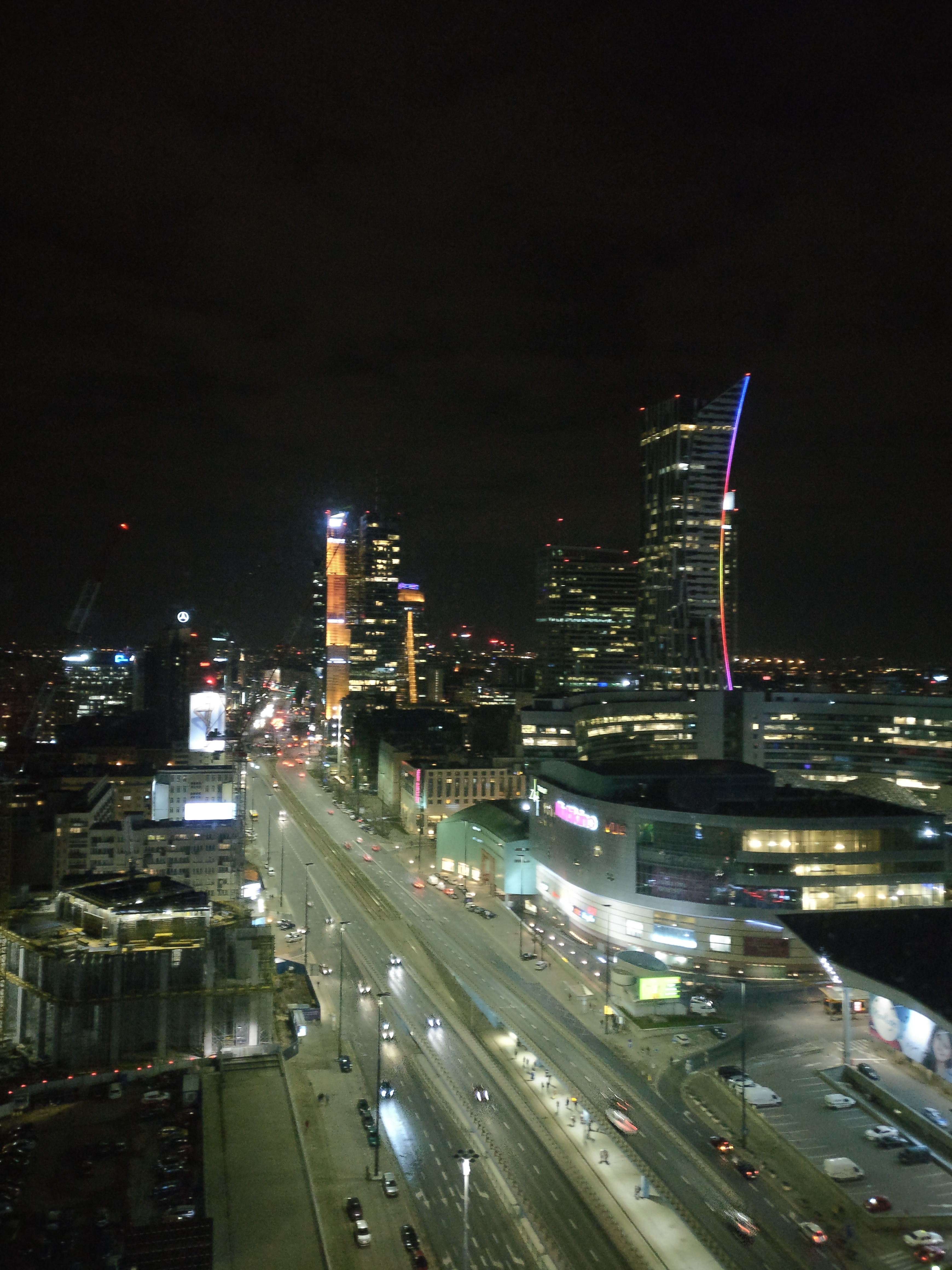
- Night view with Warsaw Spire's LED display cycling through colors
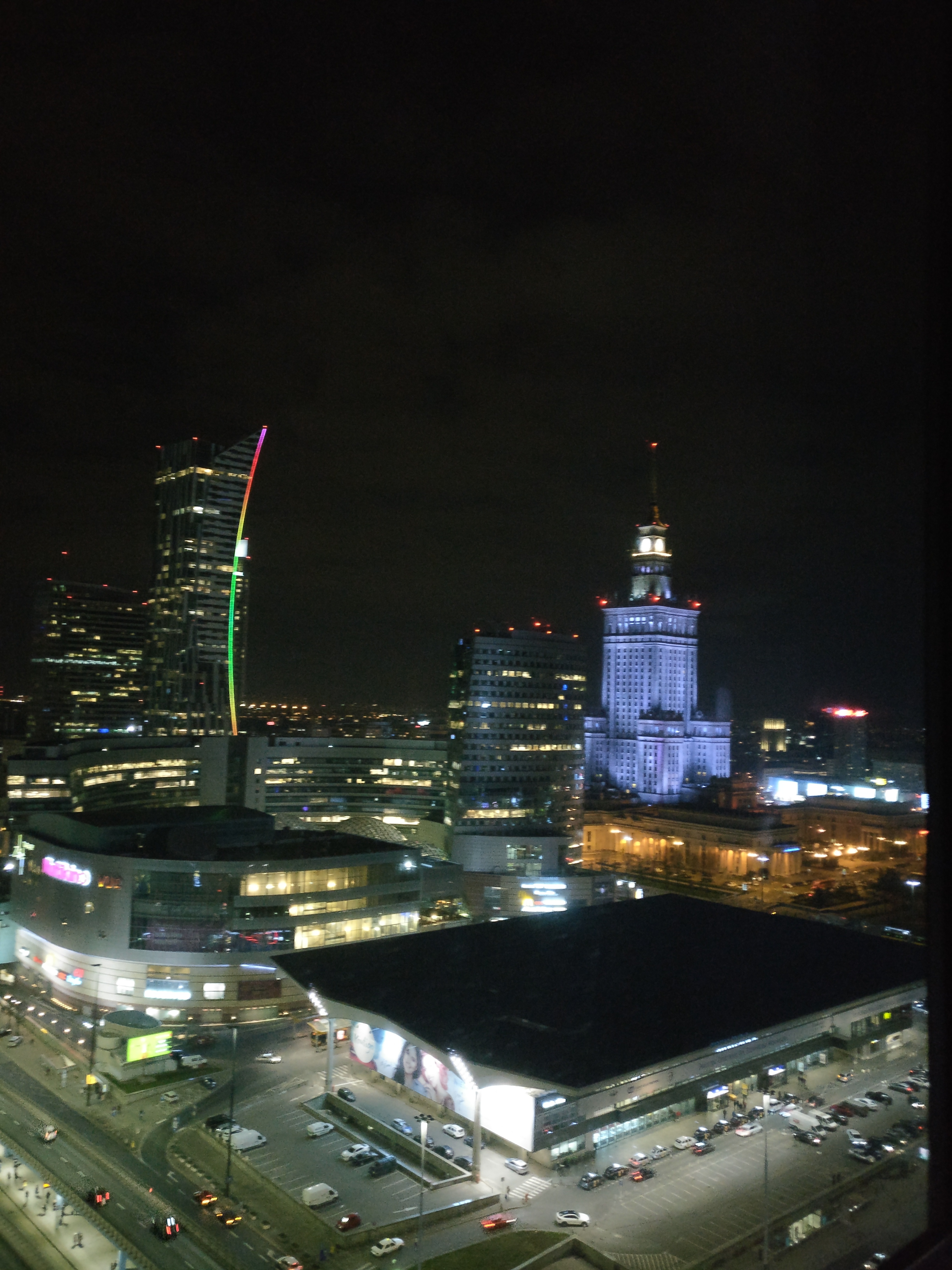
- Palace of Culture illuminated in blue-white light
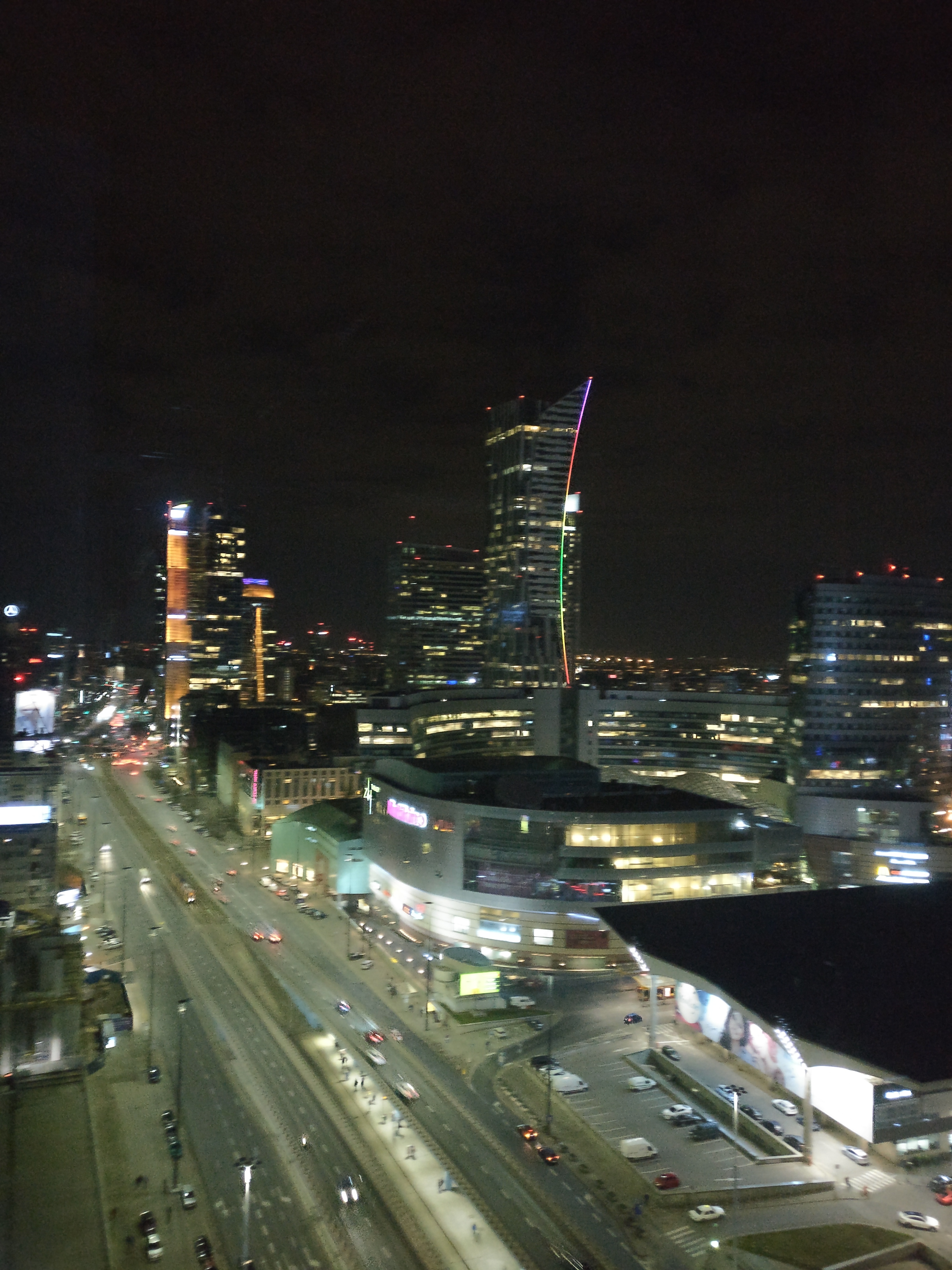
- Full cityscape showing traffic patterns and building lights
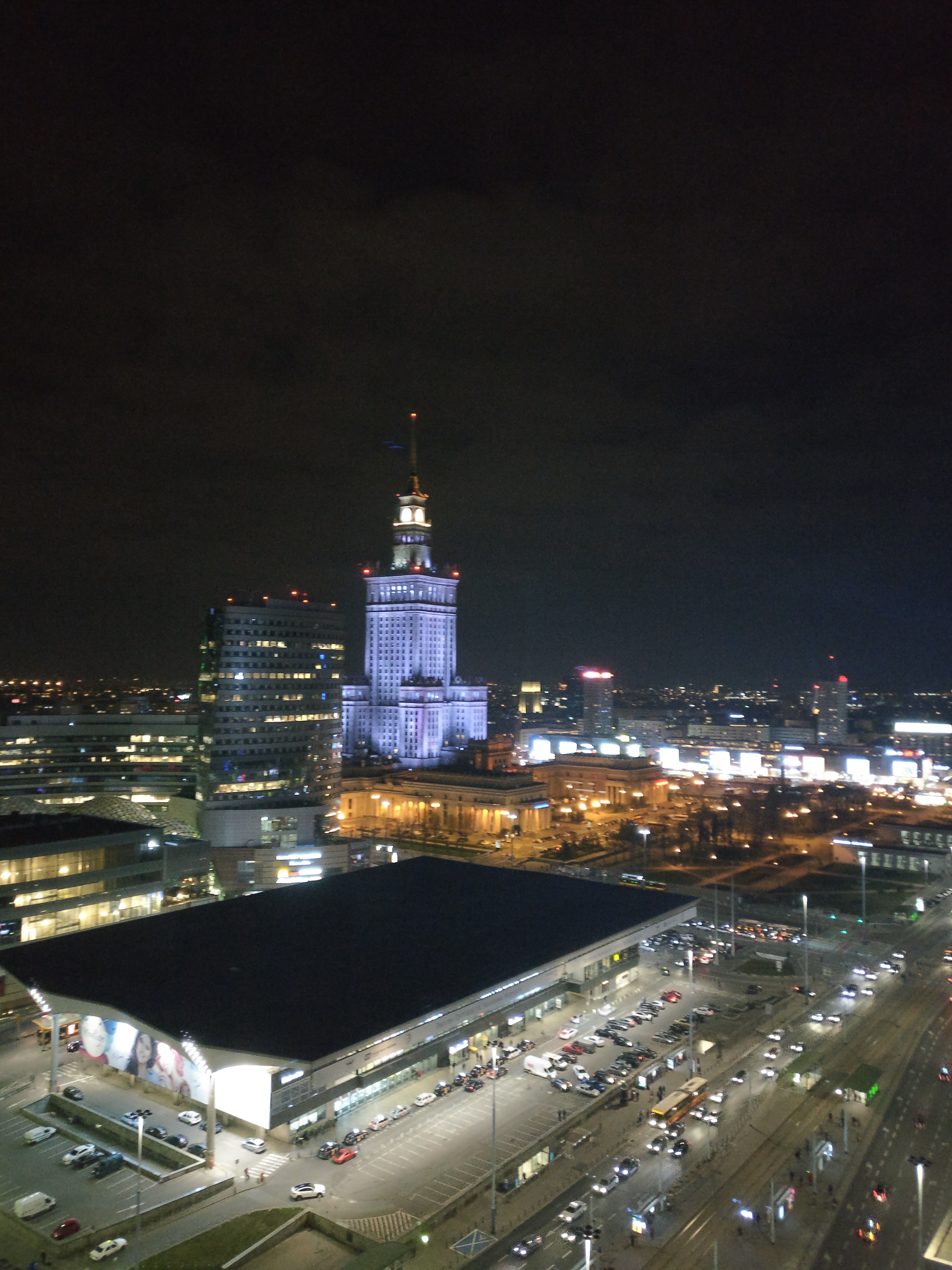
- Another angle of the illuminated Palace of Culture
These four photographs, all taken on the same evening—March 29th at approximately 21:28—document the city’s night mode. The timestamps tell their own story: I was working late, probably the only person left on our floor besides security and cleaning staff. These weren’t planned photographs but spontaneous captures during breaks from whatever task kept me there past normal hours. The Warsaw Spire’s Light Show: Corporate Spectacle
The Warsaw Spire’s most distinctive feature only emerges after dark: its LED crown capable of displaying programmable colors and patterns. In these photos, you can see it cycling through its repertoire—blue and purple gradients in one shot, shifting toward pink and orange tones in another. The building’s owners programmed various displays for different occasions: national holidays, corporate events, charitable causes.
From a marketing perspective, this made perfect sense. The Spire’s angled top was visible across much of Warsaw. By making it light-capable, the building became advertisement for itself, instantly recognizable and photographed constantly. Social media filled with Warsaw Spire photos every evening, free marketing generated by people who simply found the light show aesthetically pleasing.
From our office window perspective, the effect was less impressive than from ground level. We were nearly at the same elevation as the light crown, seeing it more or less straight-on rather than looking up at it. This diminished some of the intended impact. Ground-level observers saw the lights against dark sky, a beacon visible for kilometers. We saw them against the cityscape’s ambient light pollution, competing with thousands of other light sources.
Still, the changing colors created atmospheric effects visible in these photos. When the crown glowed blue-purple, it painted the low clouds above in matching hues. Warsaw’s typical cloud cover—maritime air masses from the Baltic meeting continental air from the east—hung low enough that building lights reflected off cloud bases, creating urban skyglow that obscured stars but painted the night sky in artificial colors.
The Palace of Culture: Illuminated History
The Palace of Culture received different lighting treatment befitting its status as historical monument. Rather than dynamic color shows, it bathed in steady blue-white illumination that emphasized its architectural details. The photographs capture this well—notice how the lighting brings out the building’s tiered structure, each level clearly delineated by careful uplighting that creates depth and shadow.
The Palace’s illumination strategy has changed over decades. During communist era, it received minimal lighting—some basic floodlights, nothing sophisticated. Post-1989, various lighting upgrades occurred, each attempting to reframe the building’s meaning. Current lighting, installed in the 2000s, aims for “dignified” presentation—acknowledging the building’s controversial origins while treating it as legitimate part of Warsaw’s architectural heritage.
At night, the Palace’s spire remained clearly visible, topped with red aircraft warning lights required for structures exceeding certain heights. These warning lights appear in the photos as small red dots—regulatory requirements rendered poetic by accident. Every tall building wore these lights, creating constellation of red stars across Warsaw’s skyline, mapping out the city’s vertical geography.
The building’s base remained lit differently than its upper sections. Ground-level illumination served practical purposes—lighting entrances, ensuring safety—while also creating commercial atmosphere for the theaters, museums, and conference halls housed within. From our elevated viewpoint, this ground-level lighting appeared as warm glow around the base, contrasting with the cooler tones illuminating the upper stories.
Traffic as Light Streams: The City’s Circulatory System
The night photographs reveal traffic patterns invisible during daytime. Each vehicle’s headlights and taillights become points of moving light, and in longer exposures or at this distance, they blur together into continuous streams. Red rivers flow one direction, white rivers the opposite direction, occasionally intersecting at traffic signals that briefly dam the flow before releasing it again.
Jana Pawła II Avenue shows this clearly—the main thoroughfare cuts through the frame as paired light streams. Even at 21:28, traffic remained substantial. Warsaw doesn’t fully sleep; there’s always movement, always transport, always people going somewhere. Night shifts start and end. Services operate 24/7. Emergency vehicles respond to calls. Delivery trucks make overnight runs to avoid daytime congestion.
The traffic signals, barely visible as colored dots at this distance, orchestrated this flow. I’d sometimes watch the patterns, noting how signal timing affected traffic density. Green waves—synchronized signals allowing continuous flow—would create sudden surges of vehicles moving through corridors. Poorly timed intersections created clots where traffic backed up, then rushed through when released.
There was meditative quality to watching traffic from this height. The individual urgency—drivers rushing to appointments, annoyed by delays, competing for position—all disappeared. From above, it became abstract pattern, beautiful in its rhythmic flow. You couldn’t see the driver frustrated by the car ahead going too slowly. You couldn’t hear the impatient horn honks or aggressive engine revving. Just smooth motion, light flowing through urban arteries. I remember standing at that window late one night—might have been one of these same nights when I took these photos—and thinking about cellular automata simulations I’d studied in university. Traffic flow models where simple rules about acceleration, deceleration, and spacing create emergent patterns of congestion and free flow. From above, watching actual traffic, you could see those patterns manifesting in reality. Mathematical models made concrete in the behavior of thousands of drivers, each making local decisions that aggregated into system-level phenomena.
The Office at Night: Solitary Professional Life
Working late in the office created strange atmosphere. During business hours, the space buzzed with activity: conversations, phone calls, movement between desks, the ambient noise of many people sharing environment. After hours, all that evaporated. The cleaning crew would come through around 19:00, their vacuum cleaners and cart wheels on hard floors breaking the silence temporarily. Then they’d leave, and true quiet would settle. Not complete silence—buildings never achieve that. The HVAC system maintained its constant low hum, cycling on and off to maintain temperature. Elevators occasionally activated, their motors and cables audible through walls as they serviced other floors. The building itself made settling noises, thermal contraction and expansion causing structural elements to creak occasionally. Somewhere distant, a phone might ring unanswered. But compared to daytime cacophony, it felt profoundly quiet.
The lighting changed too. Motion-sensor controls turned off lights in unoccupied areas, saving energy but creating archipelago effect—small islands of illumination where people worked, surrounded by dark sections of empty cubicles and conference rooms. This made the office feel larger and more maze-like. Walking to the break room meant passing through dark sections, motion sensors gradually waking lights as you progressed, leaving dimming trail behind as you moved.
These late nights often proved most productive. Email volume dropped to near zero. No one scheduled meetings. Phones didn’t ring. The constant interruptions that fragmented daytime work disappeared, allowing sustained focus on complex tasks. Programmers call this “flow state”—that mental mode where you’re fully engaged with challenging work, time passes unnoticed, and productivity soars. Late night office hours enabled flow state reliably. But there was tradeoff. Working alone in quiet office could feel isolating. The human need for social connection went unmet. Hours would pass without speaking to anyone. Your internal monologue became sole companion. Sometimes you’d talk to yourself just to hear human voice. The building’s night sounds—previously background noise—became more prominent, occasionally startling when unexpected.
Looking out the window provided relief from this isolation. The city was still out there, still active, still alive. Those lights represented other people—working night shifts, heading home from evening activities, living their lives. You weren’t actually alone, just temporarily separated by elevation and glass. The view maintained connection to human world even while physically isolated from it.
The Złote Tarasy: Architectural Bubble Below
Złote Tarasy deserves particular attention in these photographs. Its distinctive curved roof dominated the foreground in nearly every shot from our office window. Understanding this building required appreciating both its commercial purpose and its architectural ambition. The name translates to “Golden Terraces,” though the golden part was more metaphorical than literal—the building used glass and steel primarily, with some golden-toned metal accents that justified the name in bright sunlight. The “terraces” referred to multiple levels stepping down toward the lower city areas, creating accessible outdoor spaces unusual in commercial developments.
The roof structure, designed by Jerde Partnership (same firm behind many American shopping malls including Los Angeles’ Westfield Century City), was meant to evoke organic forms. The architect’s stated inspiration included both the Vistula River’s flow and the idea of Warsaw rebuilding itself—something fluid and dynamic rather than static and finished.
From our aerial vantage, the roof read as geometric abstraction. Each curved section formed approximate sphere cap, and the arrangement of these sections created overlapping pattern. The structural engineering required to achieve this must have been substantial—spanning large open spaces below while creating the appearance of lightweight fabric floating above.
The building connected to Warsaw Centralna station through underground passages, making it major transfer point in the city’s transit system. During rush hours, the plaza areas visible in our photos would fill with commuters—streams of people flowing in from the station, dispersing toward various destinations. The building’s designers anticipated this traffic, creating wide passages and multiple entry points.
At night, the Złote Tarasy glowed from within. The photos show this—warm light emanating from retail spaces below illuminating the curved roof from beneath, creating lantern effect. Individual sections of roof glowed like giant lampshades, the building’s interior lighting becoming exterior architectural feature. The retail spaces below attracted interesting clientele mix. High-end international brands occupied premium positions near main entrances—brands establishing Polish presence post-EU accession. But the building also housed typical mall tenants: electronics stores, bookshops, coffee chains, food courts. Warsaw’s socioeconomic diversity manifested in who shopped where: executives from surrounding offices browsing luxury stores during lunch breaks, students gathering in cheaper restaurants, families navigating strollers through crowds on weekends.
I rarely went there myself. The building was convenient—attached to the station I used for commuting—but I found it somehow sterile. Too clean, too designed, too optimized for commercial flow. The architecture that looked interesting from our office window felt oppressive when you stood inside it. The curved roof that created beautiful abstract pattern from above felt low and enclosing from ground level. The ambient music, climate control, artificial lighting—all the environmental engineering meant to maximize shopping comfort—made me want to leave quickly rather than linger.
But from above, with distance providing abstraction, the building regained aesthetic appeal. It became composition of curves, light, and shadow rather than commercial space designed to encourage consumer spending. This distance, this elevation, transformed everything. Commercial architecture became geometric art. Traffic congestion became flowing pattern. The city’s density and chaos became ordered beauty.
Weather and Seasonal Variations: Urban Atmosphere
These photographs captured specific atmospheric conditions worth examining. March in Warsaw occupies transitional zone between winter and spring, creating variable weather patterns. Some days brought clear skies and warming temperatures. Others delivered grey overcast and cold winds. A few saw snow flurries even as calendar declared spring’s arrival.
The afternoon photos show relatively clear conditions with high clouds. This allowed the dramatic sunset colors—insufficient atmospheric clarity prevents those rich oranges and ambers. The cloud formations visible appear to be stratocumulus—low-altitude clouds in clumps and layers, typical for maritime air masses moving over continental Europe.
The night photos show different conditions. Look carefully at the sky—it’s not clear black but rather dark grey-blue, typical of urban skyglow combined with cloud cover. Low clouds acted as reflectors, bouncing city light back down and creating ambient illumination that never fully darkened. This light pollution made star observation essentially impossible from central Warsaw, but it created its own aesthetic—the sky became canvas for city light, painted in blues, oranges, and purples depending on which districts’ lights dominated.
Wind conditions affected the building in subtle but noticeable ways. Strong winds—common in Warsaw due to its position on the Mazovian plain with few natural barriers—made the building creak and flex. Not dangerous flexing, but perceptible. You’d feel slight movement, hear structural elements adjusting. The windows would whistle or hum depending on wind angle and velocity. These sounds became familiar enough that you stopped consciously noticing them, but visitors would sometimes comment nervously.
Temperature differences between inside and outside became visible on windows. During cold evenings, condensation would form on the interior glass surface near edges where thermal bridging occurred. This created interesting visual effects—blurred areas around frame edges, sometimes patterns of frost on particularly cold nights. Photography through these windows required shooting through clear central sections to avoid the blur. Seasonal variations in light levels dramatically affected office atmosphere. March brought gradually lengthening days—sunset moved roughly two minutes later each day. This created anticipation: would today be the day we left work with sunlight still present? By late March, this became possible, though our office culture of extended hours meant many still departed after dark regardless of sunset time.
Winter months had been psychologically challenging. Arriving at work before sunrise, leaving after sunset, spending all daylight hours indoors under fluorescent lighting. Vitamin D deficiency became common joke among colleagues. The view helped—at least we could see the sun during its brief appearance, even if we couldn’t step outside to feel it. Some people positioned desks to maximize sun exposure during that precious 30-45 minutes when low winter sun directly illuminated our office space.
Technical Considerations: Smartphone Photography from Windows
These photographs were captured using smartphone camera—probably iPhone or similar device typical for 2019. This introduced specific technical limitations and characteristics visible in the images.
Dynamic Range Challenges
Smartphone sensors struggle with high dynamic range scenes—situations where bright and dark areas exist simultaneously. The sunset photos demonstrate this: well-exposed foreground means blown-out sky, or properly exposed sky means underexposed foreground. The photos attempted to balance, compromising on both, visible in how sunset colors saturate while foreground details remain somewhat dark. Modern computational photography partially addresses this through HDR (High Dynamic Range) merging multiple exposures at different settings. However, 2019-era smartphones had less sophisticated implementations than current devices. Results often showed halos around high-contrast edges or unrealistic color tones when HDR processing failed to properly merge exposures.
Window Reflections
Shooting through glass introduces reflections—internal room lighting reflecting off window surface overlays onto external scene. Look carefully at night photos and you can see subtle double-exposures: ghostly reflections of office lights appearing as faint dots or streaks superimposed on cityscape. Photographers shooting through windows use various techniques to minimize this: pressing camera directly against glass, using black cloth around lens barrel to shield from internal light, shooting at angles where reflections move out of frame. These phone photos show some reflection artifacts because casual shooting didn’t employ those techniques. But the artifacts remained minor enough not to significantly degrade images—just subtle reminders that these documented reality rather than attempting professional photography.
Noise in Low Light
The night photographs show visible noise—that grainy quality especially apparent in dark sky areas. Smartphone sensors, being physically small, struggle in low light. To maintain reasonable shutter speeds preventing motion blur, camera increases ISO sensitivity, but higher ISO amplifies sensor noise alongside signal. 2019 smartphone cameras had improved significantly from earlier generations—noise reduction algorithms had become more sophisticated, sensor technologies had advanced. But physics remained physics: small sensors capturing low light levels inevitably produced noisier results than larger sensors or longer exposures would allow.
Focus and Depth of Field
Smartphone lenses, due to their tiny sensor size, have inherently large depth of field—most things from moderate distance to infinity appear in focus simultaneously. This differs from professional cameras with larger sensors where selective focus isolates subjects. In these cityscape photos, essentially everything appears sharp—near foreground (Złote Tarasy roof), middle distance (Warsaw Spire), and far background (Palace of Culture) all maintain focus. This characteristic suits documentary purposes well. The photos aren’t trying to create artistic bokeh or isolate specific elements; they’re recording the entire scene. The comprehensive sharpness ensures all details remain visible, from foreground architectural elements to distant building facades. Personal Reflection: What These Images Preserve
Looking at these photographs now, years after taking them, I’m struck by what they do and don’t preserve. They captured the physical scene accurately enough—the buildings, the light, the atmospheric conditions all represented faithfully within the technical limitations discussed. But they can’t convey everything that made those moments significant.
They don’t capture the sounds: the constant traffic drone mixing with wind noise against windows, the HVAC system’s rhythmic cycling, the distant sirens occasionally puncturing ambient noise, the silence of late-night office hours broken only by my keyboard clicks and occasional sighs of frustration or satisfaction.
They don’t preserve the smells: the coffee from the break room gradually growing stale throughout the day, the cleaning supplies scent that hung in the air after cleaning crew departed, the particular odor of overheated electronics in summer when air conditioning struggled to keep up, the subtle mustiness of old building ventilation systems.
They don’t show the people: colleagues who became familiar through daily proximity even when we rarely spoke, the security guard who worked night shift and made small talk during late departures, the cleaning staff whose faces I recognized but whose names I never learned, the other late workers visible in surrounding office buildings, their silhouettes moving behind lit windows.
They don’t communicate the emotional context: the frustration of projects going wrong, the satisfaction of problems solved, the boredom of repetitive tasks, the stress of approaching deadlines, the relief of Friday afternoons, the particular loneliness of working alone in empty office building. But they do preserve something important: the view itself. That constant presence that accompanied an entire chapter of my life. When I think back to 2019 and my time working in that office, this view represents one of the clearest memories. Not specific projects or meetings or tasks—those have blurred together or disappeared entirely from memory. But standing at that window, coffee cup warming my hands, watching the city below, feeling both connected to and separated from the urban life flowing around me—that remains vivid.
The photographs serve as anchors for these memories. Looking at them now triggers recollection of specific moments, specific thoughts, specific feelings associated with that place and time. They function less as pure visual documentation and more as keys unlocking broader experiential memory. This is perhaps photography’s real value—not capturing objective reality (cameras can never fully achieve that) but providing triggers for subjective memory. The image itself matters less than what it evokes in the viewer who was present when it was captured. These cityscape photos probably mean little to someone who wasn’t there. But for me, they’re dense with associations and memories that the pixels themselves can’t contain but somehow still communicate.
Conclusion: The View That Remains
That office job ended, as all jobs eventually do. I don’t work there anymore, don’t commute to that building, don’t stand at those windows watching Warsaw below. The desk I occupied now belongs to someone else. Maybe they appreciate the view as I did. Maybe they keep their backs to it, preferring to focus solely on screen and tasks. Maybe they’ve become so accustomed to it that they no longer consciously notice the spectacular cityscape available just by looking up.
The city continues its transformation. Those construction cranes visible in 2019 photos have completed their projects and moved on. New cranes have taken their places at different locations. Buildings under construction in these photos now house offices and apartments. The skyline has changed, as skylines always do in cities ambitious enough to keep building. The Warsaw Spire still lights up nightly, its LED crown cycling through colors. The Palace of Culture still stands watch, still controversial, still impossible to ignore. Złote Tarasy still funnels commuters and shoppers through its curved spaces. The traffic still flows along Jana Pawła II Avenue, rivers of light after dark.
What has changed is my relationship to these views. What was daily reality has become memory. What was taken for granted—of course that view exists; I see it every day—has become precious because it’s no longer accessible. Distance transforms everything. The view I barely thought about during long working days now seems remarkable in retrospect.
This might be universal pattern in human experience. We fail to fully appreciate what surrounds us daily until it becomes past tense. The ordinary becomes extraordinary only after it’s gone. We photograph things casually, unaware we’re preserving something we’ll later treasure specifically because we can’t recreate it.
These photographs preserve a specific time and place and perspective. They document Warsaw in 2019 from specific windows in specific building during specific atmospheric conditions. The exact combination of factors will never recur. Even if I could return to that same building, same floor, same windows, it wouldn’t recreate the experience. Different time, different light, different weather, different frame of mind. But that’s fine. These images serve their purpose perfectly: preserving enough to trigger memory, providing visual evidence that this experience existed, capturing beauty that I was privileged to witness daily for that period of my life.
To anyone currently working in similar situations—offices with views you barely notice, scenes you pass by daily without really seeing—I offer this suggestion: occasionally take photos. Not carefully composed professional images (though those are nice too), but casual documentations of your everyday surroundings. Because someday, those surroundings will become past tense, and you’ll be glad to have visual records of beauty you were too busy to fully appreciate while it was present.
The view from that Warsaw office window taught me something about perspective: how elevation changes everything, how distance transforms chaos into pattern, how observing life from above provides both connection and separation. But most importantly, it taught me to occasionally look up from immediate tasks and simply observe the world. Because the world is beautiful, cities are fascinating, and moments of simple observation become precious memories when given the chance.
These photographs are all that physically remain of those days. But the memories they preserve—of standing at windows watching Warsaw transform through light and season and time of day, of finding peace in urban observation, of learning to see beauty in unexpected places—those remain vivid, triggered by pixels arranged to approximate a view that once was daily reality.
Sometimes, a room with a view is more than professional setting. Sometimes it becomes classroom teaching lessons about observation, perspective, and appreciation. Sometimes it becomes sanctuary from the demands of work, offering contemplative space when needed most. Sometimes it becomes memory anchor, preserving entire chapters of life in the shape of buildings against sky. That’s what these photographs represent. Not just Warsaw’s skyline, but a way of seeing, a moment of being, a chapter of life lived at that particular elevation with that particular view. And for that, I’m grateful.
Personal Note on Workplace and Photography:
These images represent the casual intersection of professional life and visual observation. They weren’t planned photography sessions with dedicated equipment and careful composition. They were spontaneous captures during work breaks, using whatever smartphone was in my pocket, through whatever windows happened to be accessible.
This casual approach might seem limiting compared to professional photography, but it served different purpose: documenting lived experience rather than creating artwork. Professional photographers might visit Warsaw, spend golden hours at optimal locations with proper equipment, and produce technically superior images. But those wouldn’t capture this specific experience—of standing in office building, between tasks, observing the city as daily backdrop to working life.
That’s the value of casual documentation: authenticity. These images prove I was there, saw this, lived this. They preserve not ideal representations of Warsaw but actual moments from actual days. And sometimes, authenticity matters more than technical perfection. To future self reading this: Remember to keep looking up from screens. Remember cities are beautiful. Remember that ordinary days become extraordinary in retrospect. Remember to document your surroundings, even casually, because you’ll be glad you did.
This site runs on coffee and good intentions. Help keep it running?
